

 Português pt
 Español es
 العربية ar
 বাংলা bn
 Deutsch de
 Filipino fil
 Français fr
 हिन्दी hi
 Bahasa Indonesia id
 Italiano it
 Русский ru
 Svenska sv
 ไทย th
 Türkçe tr
 Tiếng Việt vi
 简体中文 zh
Updated:
NewsNasdaq Futures Fall 1.2% as Treasury Yields Hit Highest Since 2007
 Kwame MensahEditorial character · Markets Desk

Quick answer
On September 24, Nasdaq-100 futures fell 1.2% after the 10-year Treasury yield reached 5.140%, the highest since 2007, and the odds of another Fed rate hike in October rose above 75%. During the session, however, the Nasdaq Composite recovered from its opening drop and closed essentially flat.
Futures contracts on American exchanges pulled back on Thursday, September 24, with technology leading the losses. Nasdaq-100 futures fell 1.20%, to 30,397 points; S&P 500 futures dropped 0.69%, to 7,718.75 points; and Dow futures lost 0.44%, to 51,646 points.
Yields at their highest since 2007
The pressure came from interest rates. The 10-year Treasury yield hit 5.140%, the highest since July 2007. The 2-year yield reached 4.897%, a high since 2023, and the 30-year yield hit 5.438%, the highest since 2004. Strong activity data and higher fuel and shipping costs reignited inflation fears.
With that, the odds of another Fed rate hike in October jumped from about 49% to over 75% in a week. The central bank had already raised the rate to a range of 3.75% to 4%, the first increase since 2023.

Why higher rates hit technology harder
A stock's price largely reflects the present value of the profits the company is expected to generate in the future. When U.S. Treasury yields rise, that discount gets bigger, and distant profits are worth less today. Technology companies with high valuations depend more on profits expected many years out, which is why they tend to feel the impact of rising rates more than sectors with more immediate profit.
There's also a comparison effect: with a government bond paying over 5% a year, some investors start demanding a higher return from stocks to keep taking on stock-market risk.
Reaction outside the United States
The bad mood spread: China's CSI 300 fell 1.73%, Australia's ASX 200 dropped 0.66%, and Europe's Stoxx 600 opened lower. Japan's Nikkei was the exception, up 1.66%.

What the chart showed afterward
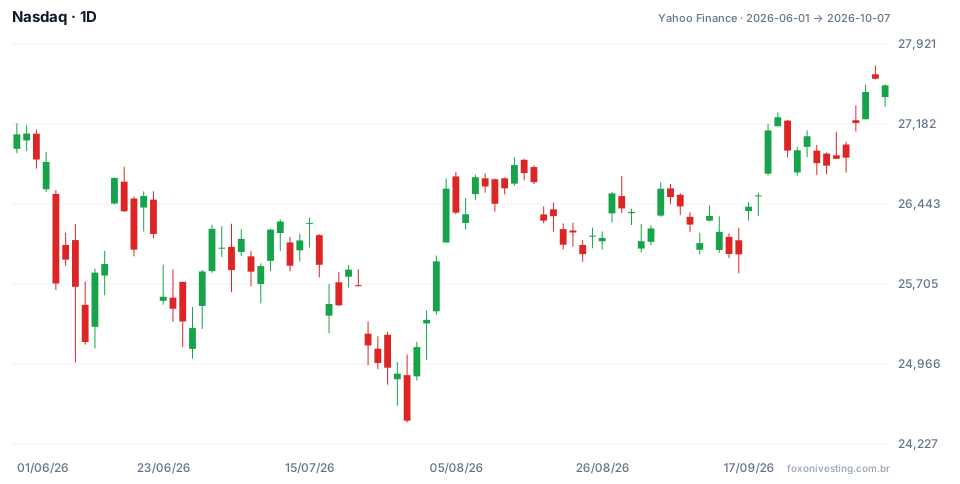
The chart shows the Nasdaq Composite index, which includes all stocks listed on the Nasdaq and isn't the same as the Nasdaq-100 futures contracts mentioned above, but tends to move in the same direction. In the September 24 session, the index opened at 26,734.51 points, 0.75% below the previous close (26,936.04), and hit 26,706.14 points at the day's low. The drop didn't hold: the index closed at 26,939.37 points, essentially flat.
The 10-year yield, measured by the ^TNX index, closed September 24 at 5.162% and kept climbing, up to 5.311% at the October 5 close. Even so, the Nasdaq Composite closed October 7 at 27,538.69 points, 2.22% above the September 24 close, after marking the period's high, 27,722.75 points, on October 6. Between June and October, the low had been 24,425.34 points, on July 29.
The episode shows that the drop in futures before the open didn't determine the day's close, and that rising rates didn't stop the index from rising in the following weeks. This describes what happened in that period, not a rule for what comes next.
What to watch
The next steps depend on the Fed's October decision and inflation data. For anyone following indices and technology stocks, the 10-year yield and the economic calendar remain direct references for understanding the sector's volatility.
Source: Traders Union.
Practice before you risk. Open your Fox On account and test your ideas on the demo account with US$10,000 in virtual funds.
Create free accountUpdated:
Editorial character of the Fox On newsroom. Articles are written by the team with the help of artificial intelligence; prices and charts come from real market data. Follows the news that moves prices — rates, stock markets, companies and commodities — explained without jargon.
Was this article helpful?
Be the first to rate it.
Comments
- No comments yet. Be the first to comment.
Ready to put it into practice?
Open your account and practice on the demo account with US$10,000 in virtual funds, without risking money.
- Secure platformProtected login and identity verification
- Multilingual supportHelp available every day
- Free demo accountUS$10,000 virtual to practice
Trading involves the risk of losing the capital invested.
