

 Português pt
 Español es
 العربية ar
 বাংলা bn
 Deutsch de
 Filipino fil
 Français fr
 हिन्दी hi
 Bahasa Indonesia id
 Italiano it
 Русский ru
 Svenska sv
 ไทย th
 Türkçe tr
 Tiếng Việt vi
 简体中文 zh
Updated:
NewsGlobal Bond Selloff Deepens on More Fed Hike Bets
 Kwame MensahEditorial character · Markets Desk

Quick answer
On September 24, 2026, the global bond selloff pushed the 10-year Treasury yield near 5.12% and the 5-year above 5%, and the market started pricing in three more Fed rate hikes over the next year. Through October 7, the 10-year yield kept climbing and closed at 5.277%, after touching 5.364% intraday.
The government bond selloff gained strength on Thursday, September 24. The 10-year Treasury yield came in near 5.12% after rising 15 basis points the day before, the biggest daily jump since the tariff turmoil of April 2025. The 5-year topped 5% for the first time since 2007, after an auction with weak demand.
The market started fully pricing in three more 0.25-point Fed rate hikes over the next year, which would take US rates from the current 3.75%-4% range to 4.5%-4.75%. Some are already hedging against a fourth hike. A resilient economy and expensive energy threaten to keep inflation above the 2% target.
A global move
The selloff wasn't limited to the United States: bonds from Japan, Australia, New Zealand, and emerging markets also fell, and the average yield on global government debt neared 4%. The dollar came close to its highest level since July, Asian stock markets fell about 0.6%, and mainland Chinese stocks, 1.5%.
Among commodities, gold fell 0.2%, to about $4,280 an ounce, and Brent returned to $103 a barrel at the time of the original report.

Why a bond's price falls when its yield rises
A bond's yield and price move in opposite directions. A Treasury pays fixed coupons; if the market starts demanding higher rates, the older bond only finds a buyer at a lower price, and the yield for whoever buys at that price rises. That's why a bond selloff shows up in headlines as rising yields.
Treasuries serve as the benchmark for mortgages, corporate credit, and stock valuations. When the risk-free 10-year yield rises, the discount applied to companies' future profits increases, which tends to weigh on growth stocks, and the dollar tends to become more attractive against other currencies.
What the data shows through October 7
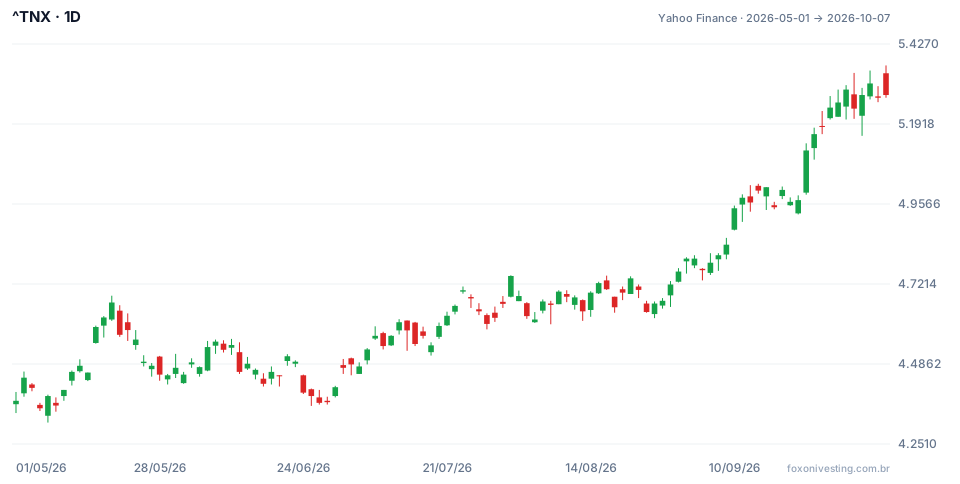
The chart shows the 10-year Treasury's daily yield (the ^TNX index, in percent) from May to October 2026. According to daily closes, the yield went from 4.968% on September 22 to 5.114% on September 23, up 14.6 basis points, and closed at 5.162% on September 24.
The rise continued in the weeks that followed. The yield closed at 5.293% on September 30 and at 5.311% on October 5, and on October 7 it touched 5.364% intraday, the period's high, before closing at 5.277%. On May 1 it stood at 4.38%: in just over five months, the increase was about 0.90 percentage points, with a low of 4.31% on May 7.
In the other markets mentioned, gold closed at $4,298.00 on September 24 and at $4,140.70 on October 7. Brent closed at $106.60 on September 24 and at $100.20 on October 7. The euro went from $1.1448 on September 23 to $1.1254 on October 7, in line with the stronger dollar. The S&P 500, on the other hand, closed at 7,801.77 points on October 7, above September 24's 7,704.13.

What to watch
The next US inflation and growth data will show whether the bets on more Fed hikes hold up. Treasury auctions with weak demand, like the one that pushed the 5-year above 5%, also tend to move yields on the same day. The numbers above describe what happened through October 7; they don't indicate where rates are headed from here.
Source: Traders Union.
Practice before you risk. Open your Fox On account and test your ideas on the demo account with US$10,000 in virtual funds.
Create free accountUpdated:
Editorial character of the Fox On newsroom. Articles are written by the team with the help of artificial intelligence; prices and charts come from real market data. Follows the news that moves prices — rates, stock markets, companies and commodities — explained without jargon.
Was this article helpful?
Be the first to rate it.
Comments
- No comments yet. Be the first to comment.
Ready to put it into practice?
Open your account and practice on the demo account with US$10,000 in virtual funds, without risking money.
- Secure platformProtected login and identity verification
- Multilingual supportHelp available every day
- Free demo accountUS$10,000 virtual to practice
Trading involves the risk of losing the capital invested.
