
 Português pt
 Español es
 العربية ar
 বাংলা bn
 Deutsch de
 Filipino fil
 Français fr
 हिन्दी hi
 Bahasa Indonesia id
 Italiano it
 Русский ru
 Svenska sv
 ไทย th
 Türkçe tr
 Tiếng Việt vi
 简体中文 zh
Updated:
NewsCrypto Investors Overtrust the Regulated Label, Survey Shows
 Kwame MensahEditorial character · Markets Desk

Quick answer
A Traders Union survey shows that 72% of cryptocurrency investors feel safer on regulated platforms, but only 42% check the registration themselves. More than a third expects protections from regulation that it doesn't guarantee, such as loss reimbursement or protection against hacker attacks.
A Traders Union survey shows that the regulated-platform label boosts cryptocurrency investors' confidence, sometimes more than it should. 72% of respondents said they feel safer on these platforms, and 31% feel much safer.
What Each Person Understands by Regulation
The problem lies in the meaning each investor gives to the term. Only 33% associate regulation with rules and oversight, which is what it actually represents. Another 21% believe the label means their money is protected, 16% see it as proof of trustworthiness, and 14% as a sign of financial soundness.
Combined, 36% expect protection against bankruptcy, loss reimbursement, or hacker attacks, things that regulation alone doesn't guarantee.

Few Check the Registration
Verification is also low. Only 18% check an official registry and 24% look at license data, meaning 42% actually verify it. Another 22% trust what the platform itself says, 17% assume that large brokers are regulated, 14% check nothing, and 5% don't know how to do it.
The most striking figure: 37% admit they research less when the platform is regulated. In other words, the label reduces the caution of exactly the people who trust it the most.
The Fears Remain
Even with the label, the worries don't disappear: 24% fear a sharp price drop, 22% cyberattacks, and 17% the platform's collapse. The study's conclusion is that regulation raises standards but doesn't eliminate risks.

What Regulation Covers and What It Doesn't
Broadly speaking, rules for crypto-asset service providers cover authorization to operate, capital requirements, governance, anti-money-laundering measures, separation between the company's assets and its clients', and transparency with investors. In the European Union, that role belongs to the MiCA regulation. In Brazil, the legal framework for crypto-assets (Law 14,478/2022) gave the Central Bank authority to regulate companies in the sector.
None of these rules stop the price from falling. And, in Brazil, crypto-assets aren't covered by the Credit Guarantee Fund, which protects bank deposits and some fixed-income investments. Regulation reduces the risk of the company behaving badly; it doesn't turn a volatile asset into a guaranteed investment.
The Volatility No Label Removes
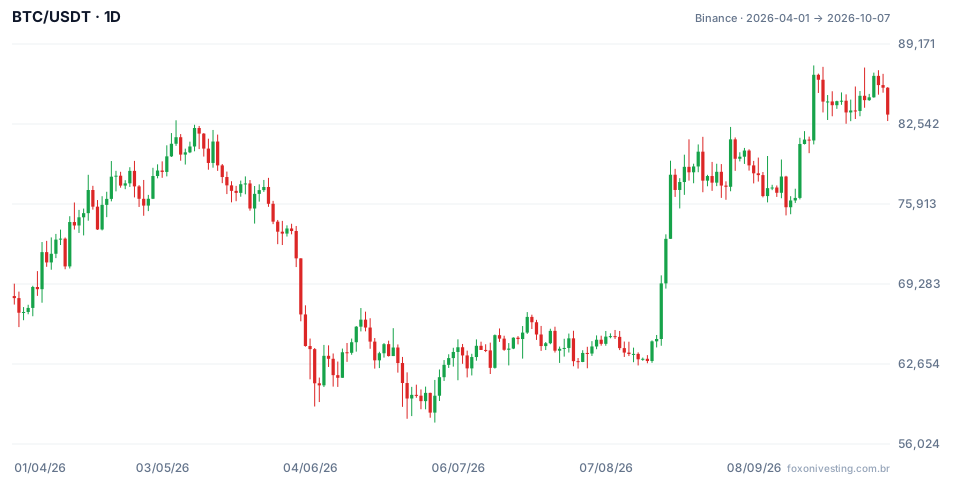
The most cited fear in the survey, a sharp price drop, helps explain the limit of regulation. On the BTC/USDT chart on Binance, bitcoin closed on April 1, 2026 at $68,113.92 and reached a low of $57,800.19 on July 1, a 15.1% pullback. It then rose to a high of $87,395.67 on September 21, a 51.2% gain from the bottom, and closed on October 7 at $83,321.81.
Those swings happened the same way on regulated and unregulated platforms. The label concerns how the company holds and handles the client's money, not the asset's behavior. The numbers above describe what happened in the period and don't indicate what's going to happen.
How to Check a Platform
The survey's central point is that verification is up to the investor themselves. In practice, that means:
- Checking the registration directly on the regulator's website, not just the number shown by the platform.
- Confirming that the licensed company's name is exactly the same as the company you're signing up with.
- Checking which country the license is valid in and which services it authorizes.
- Reading how the platform holds clients' assets and whether they're kept separate from the company's own assets.
With 14% of respondents admitting they check nothing and 37% researching less because of the label, the study's message is direct: regulation is a starting point for analysis, not the end of it.
Source: Traders Union.
Practice before you risk. Open your Fox On account and test your ideas on the demo account with US$10,000 in virtual funds.
Create free accountUpdated:
Editorial character of the Fox On newsroom. Articles are written by the team with the help of artificial intelligence; prices and charts come from real market data. Follows the news that moves prices — rates, stock markets, companies and commodities — explained without jargon.
Was this article helpful?
Be the first to rate it.
Comments
- No comments yet. Be the first to comment.
Ready to put it into practice?
Open your account and practice on the demo account with US$10,000 in virtual funds, without risking money.
- Secure platformProtected login and identity verification
- Multilingual supportHelp available every day
- Free demo accountUS$10,000 virtual to practice
Trading involves the risk of losing the capital invested.
